Wednesday, 24 September 2008

Growing pains


I'm officially a grown up. I should have known this when I stumbled into my 26th birth year with all the enthusiasm of a decomposing swan. 26 is just the wrong side, isn't it? Sure, I'm still young, but now 30 is a closer target and I can't get away with saying "I'm in my early twenties". I'm now in the mid to late twenties bracket, which is as good as saying "If I don't get my life sorted out soon, it all goes tits up from here."

I don't really think this, of course. My father, as one example, only really pulled himself together into a career when he was 30 or so. However, that is how the world at large feels. By now, I should be defining myself with a career, relationship and home. I have two of these things, but they are as focused as seeing through cataracts.

My career consists of trying to teach. I am not at ease with it for a great deal of the time, mostly because of my various social problems (i.e. not liking society very much). As for my home, I seem to be a victim of my own idealism (it exists) in that I just wanted to live in a place where I didn't have to hear street arguments or worry about people throwing cans of Strongbow onto my car. I forgot that every area has problems and nothing is perfect. My new home is actually an improvement; here, I don't get woken up at 2 in the morning by incoherent, angry voices from the next door neighbours. No, my new neighbours believe firmly in a 10 pm bedtime. In all truth, my ideal home would be surrounded by people who were do-nothings like me, all keeping themselves to themselves.

I think we can gather that I have a difficulty with the human race at large. Dinner parties or parties with unfamiliar people are like my own disaster, my own Titanic, if you will. Think of me as the unknowing ship, sailing through uncertain waters until I get blindsided by an iceberg-shaped social handicap and slowly sink beneath the waves.

I attended one such party recently. I'll say this first: everyone there was lovely. They were really nice and friendly and there was no problem there. My problem was that I realised I was now being invited to those types of parties. I'll explain: it was a nice, relaxed affair for a friend's birthday. Everyone was sitting down, casually chatting, helping themselves to bits of food. It was a grown-up party.

I've never really acted like a grown-up at a party before. I have been to parties with other grown ups, but there's a big difference. That difference was alcohol and mobility. The last party I attended was with a few people from work, but mostly strangers. However, everyone was drinking and laughing and it was a very much a party where you moved around.

The party I attended was more of a seated thing, so there's some social awkwardness right there, at least in my mind. For some people, casually chatting with strangers is an easy as breathing. I'm not one of them. That's not to say I didn't have a go, but I have this absolute, freezing fear of awkward conversations. I put it down to my inept social skills at secondary school which pretty much left me baffled about human interaction. My shyness comes across as indifference and then I start to notice I'm being shy and then I get even more wound up until finally I'm just a supremely nervous mass of stress, vibrating so fast people can't even see me move.

The other thing about this party was that it felt grown up for one major reason: no one was saying we should drink stupid amounts and do equally stupid things. No one said, "Hey, let's go to a strip club/gay bar/carnival!". People were actually engaging with each other in a relaxed atmosphere and seemed genuinely interested in what was being said. I cannot function in this situation with strangers, no matter how lovely, thanks to my aforementioned social inabilities.

I solved this problem with alcohol. 2 bottles of beer later, I ate some food. I then went through (I think) 4 vodkas and cranberry juice drinks. Quickly. I found I loosened up after that, even if I did pronounce "Seinfeld" as "Seinfield" a number of times. I knew I was truly merry as I started craving a cigarette and every other word became "fuck". My last clear memory of the party was of people complimenting cheesecakes.

I think my main issue (besides a burgeoning alcohol addiction) is that I am so used to being with people where I can see the line, it throws me when I'm with strangers. With work people, I know how to be around them (funny but not too offensive). With friends, there is no line. I say generally whatever I want. I think this is what I have become used to. Comparing watching the last 3 Star War films to being raped by George Lucas is probably not a description people at the party had heard ever before.

The problem is that it's my problem. Everyone was lovely and friendly. Couldn't have been nicer. Something in me, though, instantly turned me into an awkward, nervous mess, isolating herself. I freaked out because I suddenly realised, "I'm at a party where I must behave in a way that is not a free for all. I must not say whatever comes into my head. I must engage with nice people I don't know." This, by my definition, is a grown-up party, where you care about how you behave.

I think what really screwed me was the ratio of couples to single people. Officially, there were at least 5 couples and 3 single people besides myself and a friend. This is a greater ratio than I am used to. I have nothing against couples - I think it just serves as a reminder that I am not a part of coupledom and entry will be denied until I can work out what it's all about. I am starting to feel a little Bridget Jones.

So, I'm 26 and I've now started going to parties where you talk about holidays and other grown up things. I shall eventually acclimatise, I'm sure. A part of me, however, wonders whether I'll know when it's time to truly grow up or whether I'll be one of those sad cases who clings desperately to youthful fun well into her 40s. I hope it's the former as I can't see me doing a Peter Pan, after all.

Monday, 15 September 2008

Blind faith


There is something to be said for contemplating life. I'm just not sure what, and there in lies the charm. It's such a hugely vast subject that you could make up some random piffle, stick a question mark at the end of it and label it as a deeply profound reflection upon anything at all.

For example, if someone asks, 'Where do we come from?', you can easily cobble something together in reply: 'Ask yourself, do flowers yearn to hide in the ground or reach to touch the sky?' I've no idea what that means and yet, if you say it with a deep voice, a humble look in your eyes and a glow-in-the-dark halo held over your head, people will nod in understanding. Or throw rocks at you. Either one's an acceptable reaction to faux wisdom.

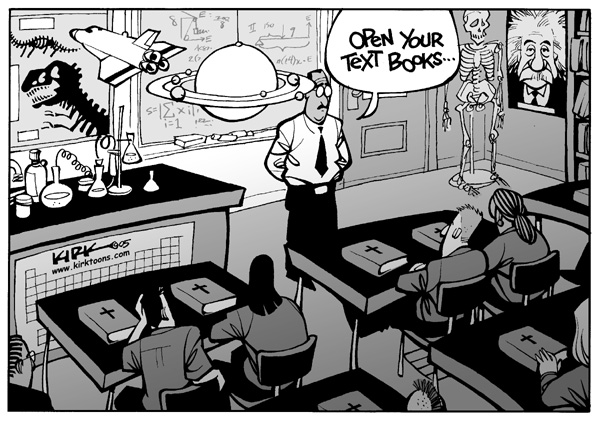
I have been contemplating blind faith (in both science and religion) because of an article I read this week about Creationism and its critics. Apparently it's making a comeback, Britney-style, though hopefully Creationism won't similarly be made to stumble up and down a stage under threat of electric cattle prod (though it seems she was in a better state this year, Gawd bless 'er, apples and pears, knees up muvver Braaaahn).

There was one particular part that intrigued me:

The Rev Greg Haslam, who preaches the creationist Christian creed to his 400-strong congregation at Westminster Chapel in London, welcomes the determination of Muslims to impart a religious-based view of the world.

"Science does not have to be taught in conflict with faith or religion," he says. "I believe the current debate over creationism versus evolution is beginning to draw more and people over to our side of the argument

"The materialist explanation of the creation has nothing to offer - if we came from nothing and go into nothing, then that encourages people to lead reckless and materialistic lifestyles.


I'm not going to argue the obvious problems posed by not defining which kind of Muslims he's agreeing with (i.e. the ones who live a better life through their spirituality and the few who want to kill people for drawing offensive cartoons). I agree that discussion of religion's conflicts with science causes mankind to move forward.

However, I have a two major problems with Creationism. One is that it shouldn't be taught in a science based environment. I'm not saying ban its mention as that path leads to Hitler impersonations (and, according to my friends, I already have something in common with him. I hope they mean I'm growing a moustache and not that I'm going to massacre millions of people as, frankly, who has that kind of time? Hitler, that's who). I encourage its mention so that differences can be drawn.

I may be preaching to the perverted here, but if science is about evidence and proof then religion, which always lists pure faith as its essential ingredient, has no place to be taught there as a scientific theory. I wouldn't expect to hear in church about how Jesus walking on water isn't physically possible, so why should Creationism get a look in during a class on evolution? By the way, it always amuses me that the physically impossible is interpreted in different ways by science and religion (science - it's physically impossible, so it didn't happen; religion - it's physically impossible, so it's a miracle and proof of divine power).

And here in lies the real problem because evolution is also a theory yet we extend it a courtesy to its flaws that we do not allow to religious beliefs. It has gaps - the missing link, for example. Creationists always jump on this as proof that evolution is rubbish. I might add that talking snakes are, in contrast, completely legit. Obviously. However, it is also general accepted opinion to believe in evolution, often without working out why you believe in it.

You see, the funny thing is, science can be every bit as reactionary as religion. Professer Michael Reiss, who also happens to be a Church of England minister as well as a director of Education at the Royal Society, stepped down from his position at the Royal Society as some of his comments about Creationism could be "open to misinterpretation", according to them. As far as I can tell, he just said that if someone brought up the issue in a science class then it should be addressed. He didn't say it should be taught as a part of the curriculum, which is what the society was jumping up and down about. If we encourage students to ask questions (I personally don't because I like to finish early), no matter how foolish they may feel, how can you ban the idea that perhaps we aren't right? Scientists at the Hadron Collider are going to be excited if all they find is nothing, because it'll show that what they thought was wrong and that there are still things to discover. Perhaps the Hadron Collider will be able to tell us some answers within the year because a part of me does think, "Actually, yes, maybe it did just happen. Maybe we're just one of a cycle of universes, continuously exploding and imploding, each Earth different from the last." Just because something's hideously unlikely doesn't mean it's divine.

One other issue I have with Creationists is this assumption:

"The materialist explanation of the creation has nothing to offer - if we came from nothing and go into nothing, then that encourages people to lead reckless and materialistic lifestyles.

I know plenty of atheists and they seem to live good lives without resorting to Grand Theft Auto lifestyles. What encourages people to lead terrible lives is a lack of belief in anything or anyone, not just God. Anyway, what's wrong with being "reckless and materialistic" for a time? I lead a "reckless and materialistic" life (I have a deep love of dvds, for example), but I also rescue puppies and kittens from bad owners (ok, no I don't, but I have the slight inclination to do so and that at least indicates a heart).

My point is, you can be "reckless and materialistic", but that doesn't mean you live that way forever. Maybe you start a family and believe in that. Maybe you find the strength to be better thanks to amazing friends. Christians would argue that this is proof of God working through people but that sounds a little bit like an over-eager father taking total credit for his football-sensation son's achievements.

Creationists shouldn't get all het up about people arguing against their beliefs, but then again, neither should scientists. The problem is when they both just go along with what they're told without pausing to think objectively. I was recently reminded of the Milgram experiment conducted many years ago. Milgram was an unethical genius. His experiment was designed to find out just how much people would follow an authority figure (I believe it was influenced by the Nazi example). A subject was placed in a room in front of a device which was hooked up to another person in a different room. A man in a white coast instructed the subject to shock the other person if they got an answer wrong to the questions they were asked. The subject was able to hear the other person's reactions to the shock. As more questions were answered incorrectly, the shock level would be increased, despite growing pleas from the person next door. The dial went up to dangerous levels and the majority of subjects, though hesitant, would continue the shocks up to dangerous levels, despite the agonising cries from the other person. This was because the man in the white coat told them to keep going.

I might add that there was no other person, that it was faked. However, the subject didn't know that. They just kept going because an authority figure told them to, even when the other person went silent after crying he was having a heart attack. This is kind of how I view people who listen only to science or religion with no room for discussion - subjects going along with whatever's handed to them because actually thinking about things is up to the higher authority, be it God or a scientific institution.

I have to take the view that people who hide behind blind belief in religion or science deserve every argument that comes their way. 47% of America, for example, believes in Creationism and I have to assume that, in the great U.S of A, it's not just the other 53% who occasionally do bad things. It's possible that religion or science aren't responsible for people leading good lives or doing hideous things and that religion or science as an explanation for how you act is just an excuse. Maybe, if you're going to believe blindly in science or religion, you shouldn't be surprised when you have to defend it.

Wednesday, 3 September 2008

Ode to Complaining


I have recently found myself devoid of ranting material. I mean proper, philosophical ranting. I'm personally amazed about this occurrence as I am a) an easily irritable woman and b) a professional grump. This sad state of affairs has been brought about by the recent upheaval in my life. In the last two weeks, I have finally managed to start driving again, assisted on a film shoot, moved house and started back at work. This leads me back to a theory I've always held, which is that if you've got time to think then you aren't busy enough.

I do not mean that we should all perpetually grind ourselves into the ground (on the other hand, this would mean less people around to bother me - it's a double-edged sword). My God, though, I never realised how much complaining has become a daily form of life. It's near impossible to spend a day without someone spinning you a yarn about the latest catastrophe involving their puppy, Mr Miyagi (you know I'm totally going to get a pet and ruin its life by naming it that). I have nothing against the occasional gripe. It is, after all, a very useful way to relieve stress - there are better, dirtier ways to relax, but not ones your boss would approve of at 10:30 am in the office. It's just not hygienic and you know it.

There has been much to moan about recently, but not much to rant about: various companies have told me my post code doesn't exist; BT seem to live in an alternative reality where they turn on your phone line and charge you for it, but do not accept its existence even when you call from that number for help (a Kafka-esque nightmare if ever I heard one); the local utilities do not understand the concept of reading the right meters; and finally, I've been trying to do all this whilst keeping my head around a film shoot budget. Actually, the last one has been the least stressful of them all, but it's a compounding factor.

Of course, there is a difference between ranting and complaining, at least in my opinion. Ranting is done after taking stock of the world and railing against its flaws in order to make people think. Complaining is done when you can't find a good pair of shoes and need to communicate annoyance to the world purely to pay it forward. However, I have only complained of late, not ranted. The main reason is that being kept busy with relatively minor things prevents you from thinking. And I have to tell you, for me that's bliss.

Reflection, pondering, navel-gazing – call it what you will, it has never done me much good. When I do have the time to sit down and ruminate upon my life, I have never enjoyed it. I am sure the quick answer to that is, "Well, you should change what you don't like". Whilst I'm sure that is a sage piece of Tricia advice, it doesn't work for me. In all fairness, I am a defeatist by trade so I'm screwed before I even start to read "inspirational living" newspaper supplements (I never really wanted a £200 leather magazine rack, anyway). The real heart of the problem is that I will never be honestly happy. Sure, I can say that if I lost weight/got a boyfriend/found a new job blah blah blah, I would be happier. For a lot of people, this would be true. I'm not those people, though. Being highly self-critical pretty much guarantees that happiness will always be just one more cream cheese Ryvita out of reach.

I have to believe, therefore, that complaining is a deliberate way of preventing us from thinking. If your mind is filled with petty concerns (did I take the rubbish out? why is she looking at me like that? where's my car?), it's harder for it to ponder the stuff that really breaks your heart (why did it happen? is there any point? when will my pizza arrive?). Those ideas, apart from the pizza, are the stuff that brings you down. Small, minor things can be more easily dealt with than questions about the cosmos. Also, in my case it's always a good idea to avoid being down as my past indicates that I have a difficulty getting back up again.

It used to frustrate me that people could wax lyrical about the crappy service they received from their phone company but had no idea about human rights violations happening in this country. Until, of course, I realised that public discussion in everyday life of the latter was purely about finding something to talk about as well. Now I'm a convert to open complaining, especially to people who hate hearing it as it gives them something to moan about and so on. It's like a cynical circle of life.

There are some who say that it is counterproductive, that you achieve nothing substantial as complaining makes you think you're changing something when actually you're just talking about it. The English are a brilliant example of this with their easy irritability and contempt for people serving them. Only in England would you find people who recount their various hardships with the wounded voice of an injured puppy, yet then dismiss all concerns with the martyr-inspired, "Well, that's life, isn't it?". I do not disagree that complaining is usually a waste of time, achieving little. In fact, I think that's one of its strengths. Talking about a problem often helps to put things into a wonderful perspective as, eventually, someone will tell you to shut the fuck up about the way the neighbours leave their bins. You will soon realise that your annoyances have become obsessions, ones which would go unchecked if not voiced.

My point, if I had to make one up, is that we often do not realise how intrinsic general moaning about the trivial actually aids our everyday survival. We complain about complaining, but why? Complaining is good for three things: it disperses anxiety; works a useful bonding exercise (you'd be amazed at how well you get on with another person if you share a mutual hatred of something); and allows instant distraction from the things that actually wake you up in the middle of the night. Bitching each day keep the doctors away, or so I find.

Having said all that, I must concede that sex is a better way of achieving those three things. And, if the sex is just god-awful, at least you'll have something new to complain about.